
Description
Halloween Fun Meets Hands-On Learning at Wes Watkins Technology Center
The Riley Report | By Jerry Riley, YCCUON
WETUMKA, OKLAHOMA — October 31, 2026
I had the pleasure of spending part of my Halloween Saturday at Wes Watkins Technology Center in Wetumka, Oklahoma, where the school’s annual Trick-or-Treat Trail was underway.
And while there was certainly plenty of candy, costumes, and Halloween excitement, I discovered that this event was about much more than trick-or-treating.
It was also an opportunity for families to visit classrooms, meet instructors and students, and get a firsthand look at some of the outstanding educational programs available right here in central Oklahoma.
Earlier in the week, I had visited with Ms. Merida Tomb about the upcoming celebration. She explained that the event would be held indoors, rain or shine, allowing families to enjoy a safe Halloween activity while exploring the technology center.
After spending some time visiting the different departments Saturday, I can tell you there was certainly plenty to see!
A Halloween Tradition That Keeps Growing
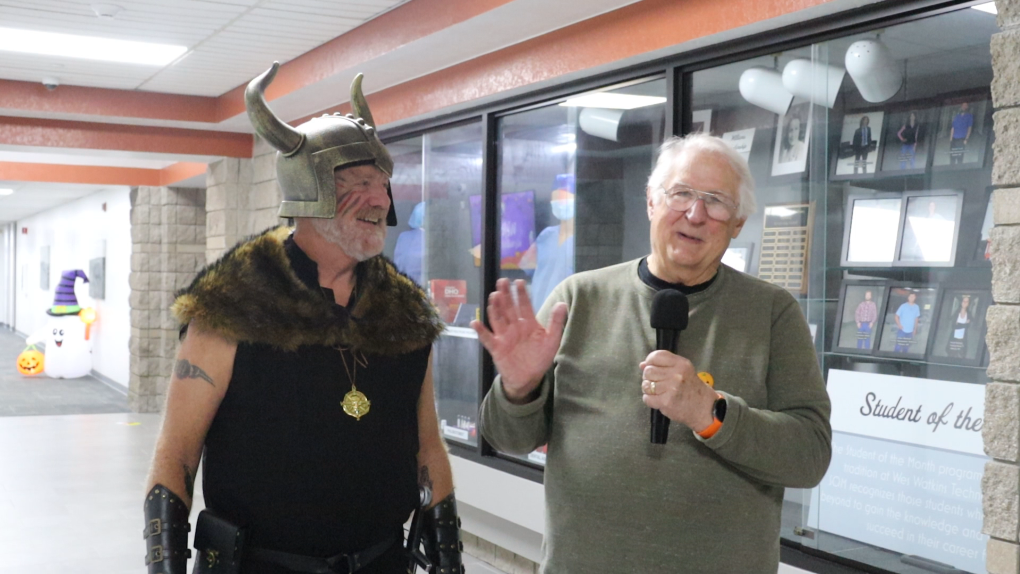
One of my first conversations was with Superintendent Vic Woods, although I must admit I almost didn’t recognize him in his Halloween costume.
Mr. Woods explained that the Trick-or-Treat Trail began approximately four years ago when the school’s communications and marketing staff came up with the idea.
What started as a community activity has become an annual tradition, attracting more than 300 visitors each year.
“We’ve had 300, a little over 300 people every year,” Mr. Woods told me.
But as he explained, the event accomplishes something beyond providing Halloween entertainment. It brings children, parents, and other community members into the school’s facilities, giving them an opportunity to become familiar with the different educational programs offered at Wes Watkins.
Of course, I couldn’t resist asking Mr. Woods whether his Halloween costume was also what he normally wore to school board meetings.
“This is the way I dress every day,” he replied.
I had to laugh at that one!
That friendly atmosphere was something I encountered throughout my visit.
Real Hearts, Eyeballs, and a Little Halloween Science
One of my most fascinating stops was the biotechnology classroom, where I visited with instructor Cappy Coleman.
Now, if you’re looking for something a little unusual on Halloween, this classroom certainly had it!
I’m talking about real sheep eyeballs, pig hearts, and even a cow heart.
And these weren’t Halloween decorations. They were actual biological specimens used in the school’s science program.
Ms. Coleman explained that students study advanced science subjects designed to prepare them for college-level coursework and careers in fields such as nursing and other healthcare professions.
The program begins with forensic science, including crime scene investigations and fingerprinting, before progressing into DNA analysis, protein synthesis, and even CRISPR technology.
I found that particularly interesting because these are subjects that many students might not otherwise encounter until they reach college.
As we talked, trick-or-treaters continued coming through the classroom, collecting candy and getting an opportunity to see some of those real specimens.
Ms. Coleman also introduced me to Alyssa, a student who had been in the program for only about two months.
I watched her working with the specimens, and she appeared to know exactly what she was doing.
Her instructor was quick to praise her.
Ms. Coleman explained that Alyssa had already become very comfortable working in the laboratory and was doing an outstanding job.
Of course, with all those hearts and eyeballs on display, I couldn’t resist asking whether any of them were edible.
“Definitely not edible,” Ms. Coleman assured me.
Well, I suppose that answered that question!
But seriously, I was impressed with the advanced science education these students are receiving and the confidence they’re developing through hands-on experience.
Learning to Care for Children — Even Babies That Cry
My next stop took me into the Early Childhood Education area, where I visited with instructor Debbie Fogle and one of her students, Caleb, who attends school in Wetumka.
I’ve actually visited this department before, and one of the things that has always fascinated me is their use of realistic baby simulators.
And yes, these babies actually cry!
Ms. Fogle explained that the program prepares students interested in becoming teachers or pursuing other careers involving children.
Students learn about child development, different learning styles, children’s behavior, and the importance of understanding how to work with young people.
But one of the most interesting teaching tools is the Realityworks baby simulator.
These realistic infant models can be programmed to cry and require students to respond appropriately.
I asked Ms. Fogle whether the baby would actually stop crying if the student did the right thing.
She assured me that it would.
Students must learn how to hold, feed, change, and comfort the baby. When they respond correctly, the simulator reacts accordingly.
I thought that was a particularly valuable teaching tool because it gives students a better understanding of the responsibilities involved in caring for an infant.
But Ms. Fogle emphasized that the program goes beyond caring for babies.
Students also learn how to work with children who have different personalities, behaviors, and learning styles.
And those communication skills can benefit them in almost any career they eventually pursue.
One thing that particularly impressed me was the affection Ms. Fogle expressed for her students.
“I want them to know they’re loved, they’re accepted,” she told me.
I think that says a great deal about the kind of learning environment she’s working to create.
She also explained that participating high school students can earn high school credits while receiving this specialized training.
Preparing Tomorrow’s Healthcare Professionals
Another interesting stop was the Health Science Careers Department, where I had an opportunity to visit with instructors and students while they welcomed a steady stream of trick-or-treaters.
The program offers high school juniors and seniors an opportunity to explore several healthcare careers, including nurse assisting, dental assisting, veterinary assisting, phlebotomy, and radiology.
I learned that students select a particular program of study and complete required classroom instruction in subjects such as anatomy, physiology, and medical terminology.
But what I found especially interesting was that their education doesn’t stop in the classroom.
Students also participate in clinical experiences at hospitals, nursing homes, and other healthcare facilities.
That means they’re getting actual experience in the healthcare environment before completing their training.
During our conversation, I noticed what appeared to be an artificial arm used for practicing blood draws.
I asked about it and learned that it was a phlebotomy training arm.
Students must demonstrate their skills using the practice arm before they’re allowed to progress to drawing blood from actual people.
Naturally, that raised another question.
I wanted to know who volunteered to let students practice drawing blood!
One of the instructors explained that sometimes the instructors themselves serve as volunteers.
Now, that’s what I call having confidence in your students!
I asked whether they had experienced any misses, and they assured me that the students were well prepared before moving on to actual volunteers.
I also visited with student Jaycilynn Huggins, who was enrolled in the long-term care aide program.
She explained that she was in her second year and was nearing completion of her current training.
Her next goal is to continue into radiology.
When I asked how she liked the program, her answer was immediate.
“I love it.”
She also had some very complimentary things to say about her instructors.
Naturally, I had to ask whether all those compliments might earn her some extra credit.
We had a little fun with that one!
But beneath the laughter was something important: a student who clearly enjoys what she’s learning and has a definite direction for her future.
That’s exactly what career and technical education is intended to accomplish.
From Halloween Music to Drones and Podcasting
One of my final stops was the Visual Communications Department, where I visited with Gunner Fulbright and Olivia Fulbright.
As trick-or-treaters entered the room, I noticed that the music was being changed to match the Halloween characters coming through.
I thought that was a pretty creative touch!
But the department itself was even more interesting.
I learned that students are involved in graphic design, photography, videography, drone technology, and various aspects of business communications.
They develop skills used in creating logos, brochures, packaging, promotional materials, and other types of visual content.
Having worked with video production, advertising, and digital media through YCCUON, I found this department particularly interesting.
I had actually visited the area earlier in the week during the school’s Sophomore Showcase and noticed what appeared to be a podcasting studio.
So naturally, I wanted to learn more about it.
I was told that the department had added a new podcasting station last year, giving students an opportunity to learn recording techniques, sound editing, audio production, and publishing.
Students are also preparing for upcoming competitions where they can put those skills to use.
And then there were the drones!
During my earlier visit, I had watched a small drone that appeared to be following the movements of a person.
I asked how that worked.
I learned that the department has smaller drones that can be controlled with traditional controllers or through hand movements.
The drones can also track a selected individual, allowing them to follow that person’s movements.
I found that technology fascinating.
We also discussed some of the department’s larger drones, including equipment with multiple cameras, zoom capabilities, and thermal imaging.
Those capabilities have applications in areas such as photography, video production, inspections, and public safety.
Another interesting part of our conversation involved the regulations governing drone operations.
I learned that the school offers training related to FAA Part 107 certification, which is important for many commercial drone operations.
Flying a drone may look simple, but understanding the regulations and operating it safely requires training.
As I told the instructor, technology in this field is changing so rapidly that just about the time you think you understand everything, something new comes along.
I was particularly impressed that students at Wes Watkins are getting exposure to these technologies while they’re still in school.
More Than Candy — A Look at the Future
As I continued through the school, I watched children dressed as superheroes and other Halloween characters moving from classroom to classroom.
There was plenty of candy being handed out, and judging from the smiles and excitement, everyone seemed to be having a wonderful time.
But I kept coming back to something Superintendent Woods had mentioned earlier.
This event isn’t just about Halloween.
It’s also about introducing families to Wes Watkins Technology Center and helping them understand the opportunities available to students.
And after visiting several departments, I think that’s an important message.
I saw students learning advanced science, preparing for healthcare careers, developing childcare skills, producing digital media, and working with some pretty impressive technology.
Perhaps what impressed me most was the enthusiasm of the instructors and students.
The instructors clearly enjoy what they’re doing, and the students I visited with seemed excited about what they’re learning.
For parents who may not be familiar with career and technical education, I would encourage you to learn more about the programs offered at Wes Watkins Technology Center.
Whether a student plans to enter the workforce after high school, continue into specialized training, or pursue a college education, these programs can provide valuable experience and a strong foundation for the future.
I want to thank Superintendent Vic Woods, Ms. Merida Tomb, the instructors, and the students who took time out of their Halloween celebration to visit with me.
And congratulations to everyone involved in organizing another successful Trick-or-Treat Trail.
It was a fun afternoon, an educational experience, and another reminder of the good things happening in our local communities.
Watch This Special Edition of The Riley Report
I invite you to watch the accompanying video, where you’ll have an opportunity to meet some of the people I visited with and see firsthand what was happening during the Trick-or-Treat Trail.
You’ll hear from Superintendent Vic Woods, visit several classrooms, meet instructors and students, and get a closer look at some of the programs available at Wes Watkins Technology Center.
And, of course, you’ll see plenty of Halloween costumes and trick-or-treaters along the way!
I’m Jerry Riley with YCCUON — You Can Check Us Out Now. Thanks for joining me for another edition of The Riley Report.
Connecting communities, highlighting local people, and sharing the stories
Community Discussion
0 CommentsListing Engagement
Views
459
Likes
0
Share This Listing
About This Contributor

Wes Watkins Technology Center
Member since Jan 1970
Listing Details

No comments yet
Be the first to ask a question or leave feedback on this listing!